I will show you what to me, is an exellent way to
made architecture, how we can make, with few and natural resources,
great space design, and at the same time, solve differents social
problems, one of the principal motives and preocupations of modern
architecture.
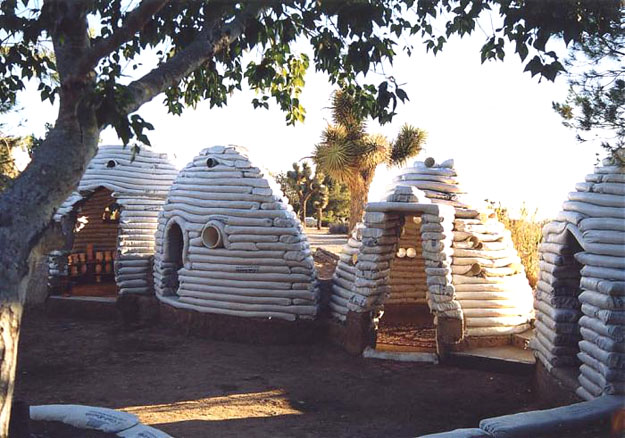
I love this structural-design-solution. I have no words to describe it, besides, my English is very poor... I try to do my best!

The global need for housing includes millions of
refugees and displaced persons - victims of natural disasters and wars.
Iranian architect Nader Khalili believes that this need can be addressed
only by using the potential of earth construction.

After extensive research into vernacular earth
building methods in Iran, followed by detailed prototyping, he has
developed the sandbag or 'superadobe' system. The basic construction
technique involves filling sandbags with earth and laying them in
courses in a circular plan. The circular courses are corbelled near the
top to form a dome.

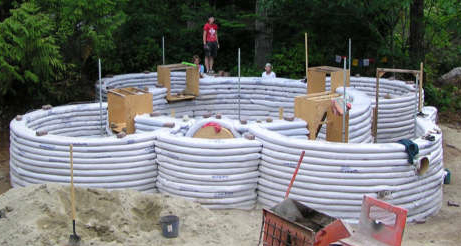
Barbed wire is laid between courses to prevent the
sandbags from shifting and to provide earthquake resistance. Hence the
materials of war - sandbags and barbed wire - are used for peaceful
ends, integrating traditional earth architecture with contemporary
global safety requirements.

The system employs the timeless forms of arches,
domes and vaults to create single and double-curvature shell structures
that are both strong and aesthetically pleasing. While these
load-bearing or compression forms refer to the ancient mudbrick
architecture of the Middle East, the use of barbed wire as a tensile
element alludes to the portable tensile structures of nomadic cultures.
The result is an extremely safe structure.

The addition of barbed wire to the compression
structures creates earthquake resistance; the aerodynamic form resists
hurricanes; the use of sandbags aids flood resistance; and the earth
itself provides insulation and fireproofing.
 Several
design prototypes of domes and vaults were built and tested. The system
is particularly suitable for providing temporary shelter because it is
cheap and allows buildings to be quickly erected by hand by the
occupants themselves with a minimum of training. The shelters focus on
the economic empowerment of people by participation in the creation of
their own homes and communities.
Several
design prototypes of domes and vaults were built and tested. The system
is particularly suitable for providing temporary shelter because it is
cheap and allows buildings to be quickly erected by hand by the
occupants themselves with a minimum of training. The shelters focus on
the economic empowerment of people by participation in the creation of
their own homes and communities.
Each shelter comprises one major domed space with
some ancillary spaces for cooking and sanitary services. Incremental
additions such as ovens and animal shelters can also be made to provide a
more permanent status and the technology can also be used for both
buildings and infrastructure such as roads, kerbs, retaining walls and
landscaping elements.
Because the structures use local resources - on-site earth and
human hands - they are entirely sustainable. Men and women, old and
young, can build since the maximum weight lifted is an earth-filled can
to pour into the bags. Barbed wire and sandbags are supplied locally,
and the stabilizer is also usually locally sourced.

Since 1982, Nader Khalili has developed and tested the
Superadobe prototype in California. In 1991 he founded the California
Institute of Earth Art and Architecture (Cal-Earth), a non-profit
research and educational organization that covers everything from
construction on the moon and on Mars to housing design and development
for the world's homeless for the United Nations.
Cal-Earth has focused on researching, developing
and teaching the technologies of Superadobe. The prototypes have not
only received California building permits but have also met the
requirements of the United Nations High Commissioner for Refugees
(UNHCR) for emergency housing. Both the UNHCR and the United Nations
Development Programme have chosen to apply the system, which they used
in 1995 to provide temporary shelters for a flood of refugees coming
into Iran from Iraq.

Khalili's educational philosophy has also continued
to develop. A distance-teaching programme is being tested for the live
broadcast of hands-on instruction directly from Cal-Earth. Many
individuals have been trained at Cal-Earth to build with these
techniques and are carrying this knowledge to those in need in many
countries of the world, from Mongolia to Mexico, India to the United
States, and Iran, Brazil, Siberia, Chile and South Africa.
 The
prototype is a symbiosis of tradition and technology. It employs
vernacular forms, integrating load-bearing and tensile structures, but
provides a remarkable degree of strength and durability for this type of
construction, which is traditionally weak and fragile, through a
composite system of sandbags and barbed wire. Created by packing local
earth into bags, which are then stacked vertically, the structures are
not external systems applied to a territory, but instead grow out of
their context, recycling available resources for the provision of
housing.
The
prototype is a symbiosis of tradition and technology. It employs
vernacular forms, integrating load-bearing and tensile structures, but
provides a remarkable degree of strength and durability for this type of
construction, which is traditionally weak and fragile, through a
composite system of sandbags and barbed wire. Created by packing local
earth into bags, which are then stacked vertically, the structures are
not external systems applied to a territory, but instead grow out of
their context, recycling available resources for the provision of
housing.
 The
sustainability of this approach is further strengthened because the
construction of the sandbag shelters does not require external
intervention but can be built by the occupants themselves with minimal
training. The system is also highly flexible: the scale of structures
and arrangement of clusters can be varied and applied to different
ecosystems to produce settlements that are suitable for different
numbers of individuals or groups with differing social needs. Due to
their strength, the shelters can also be made into permanent housing,
transforming the outcome of natural disasters into new opportunities.
The
sustainability of this approach is further strengthened because the
construction of the sandbag shelters does not require external
intervention but can be built by the occupants themselves with minimal
training. The system is also highly flexible: the scale of structures
and arrangement of clusters can be varied and applied to different
ecosystems to produce settlements that are suitable for different
numbers of individuals or groups with differing social needs. Due to
their strength, the shelters can also be made into permanent housing,
transforming the outcome of natural disasters into new opportunities.

This is how they make the roof arcs, faster, with prefabricates forms; the other ways is the manual mode.

This is the same with the windows, just put boxes or wood structures where the sandbags will NOT be...

The structures can be taller... they just add columns made of steel.

This picture is from Sacramento Mexico, look how
they adapt the structure to the normal typology of building to look more
familiar... great resolution.






 سلام
سلام